
ThousandML / Journal / Benchmark
A better 4-bit base, a better fine-tune: QLoRA on CQ vs. Unsloth NF4
We fine-tuned Qwen3.8-27B with QLoRA on Alpaca from two 4-bit bases, using the same nominal settings on a single 48 GB GPU. The CQ base reported 17.4% lower final validation loss than Unsloth's NF4 base, and lower validation loss at every one of the 10 checkpoints. It is also currently much slower per step. Here is the full picture.
17.4%
lower final validation loss
10 / 10
checkpoints with lower validation loss
15.7%
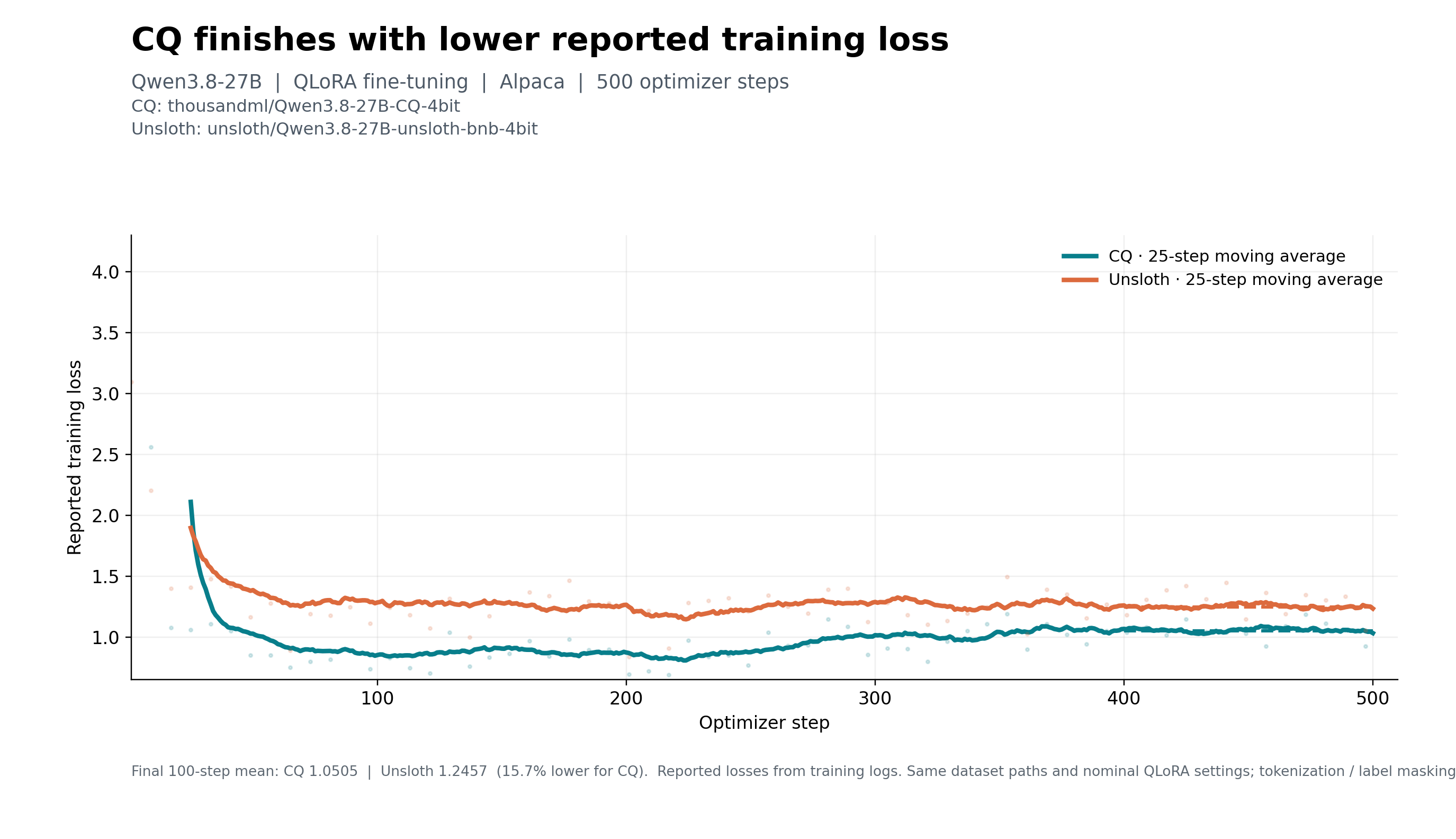
lower training loss, last 100 steps
CQ 4-bit vs. unsloth-bnb-4bit (NF4), Qwen3.8-27B, QLoRA on Alpaca, 500 steps. These are reported losses, not a downstream-task quality comparison.
Why the base matters for QLoRA
QLoRA keeps the base model frozen in 4-bit and trains small LoRA adapters on top. That is what makes fine-tuning a 27B model possible on one GPU, and what lets enterprises fine-tune in-house instead of sending private data to an outside service.
But the adapter learns a correction on top of whatever the quantized base still knows. If quantization has damaged the base, the adapter spends some of its capacity compensating for that damage. A more faithful base should leave more room to learn your task. We wanted to test whether that shows up in the training numbers.
Step 1: start from a more faithful base
First we compared the two bases against the full-precision model on WikiText-2, using KL divergence between output distributions (lower is better) and top-1 token agreement (higher is better). unsloth-bnb-4bit is the variant Unsloth uses for QLoRA.
| Quant | Disk (GB) | Mean KLD | Median KLD | 99% KLD | Top-1 agreement |
|---|---|---|---|---|---|
| CQ 4-bit | 18 | 0.0282 | 0.0128 | 0.9761 | 92.42% |
| unsloth-bnb-4bit | 22.4 | 0.0330 | 0.0144 | 1.1805 | 91.95% |
The CQ base is about 20% smaller on disk and closer to full precision on every metric. CQ does this without calibration data. That gave us a better starting point. The next question was whether it leads to a better fine-tune.
Step 2: same recipe, two bases
Both runs used the same dataset files and the same nominal QLoRA hyperparameters:
- Model
- Qwen3.8-27B
- Dataset
- Alpaca (train / validation split)
- LoRA
- r = 32, α = 32, dropout 0
- Batch
- 2 × grad accumulation 4
- Sequence length
- 512
- Learning rate
- 2e-5
- Steps
- 500 optimizer steps, eval every 50
- Seed
- 42
- Hardware
- Single NVIDIA A40, 48 GB
CQ: thousandml/Qwen3.8-27B-CQ-4bit. Unsloth: unsloth/Qwen3.8-27B-unsloth-bnb-4bit.
Results
| Metric | CQ 4-bit | Unsloth NF4 | Advantage |
|---|---|---|---|
| Best validation loss | 0.8385 | 1.2484 | CQ |
| Final validation loss | 1.0315 | 1.2484 | CQ |
| Mean training loss (steps 401–500) | 1.0505 | 1.2457 | CQ |
| Median steady optimizer-step time | 27.60 s | 3.20 s | Unsloth |
| Peak PyTorch allocated memory | 24.39 GiB | 23.83 GiB | Unsloth |
On loss, the gap is large and consistent. CQ ended at 1.0315 validation loss vs. 1.2484 for NF4, which is 17.4% lower. Its best checkpoint reached 0.8385. Unsloth's best validation loss was its final value.
The loss curves
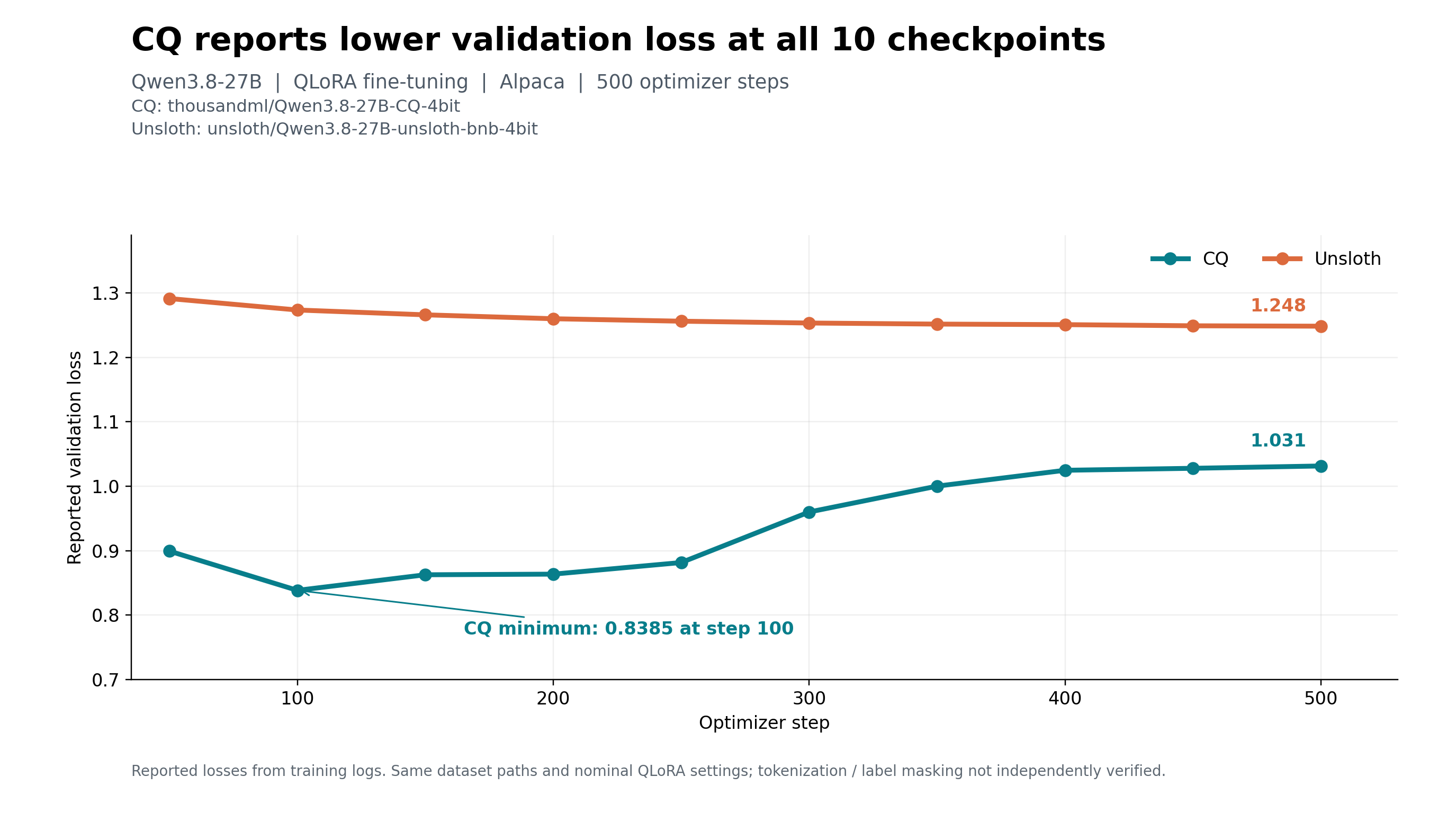
One detail is worth calling out. CQ's validation loss bottoms out at step 100 and then drifts upward, while its training loss keeps falling. That pattern usually means the model is starting to overfit Alpaca. In other words, CQ reached its best validation loss in about a fifth of the run. With early stopping, a CQ run could stop around step 100 and still beat NF4's 500-step result by a wide margin. That matters because of the speed gap below.
Where CQ is behind
CQ does not win everything. Unsloth's kernels are heavily optimized, and that shows:
Step time
27.60 s vs. 3.20 s
CQ is currently about 8.6× slower per optimizer step. This is our main focus right now.
Peak memory
24.39 vs. 23.83 GiB
The two are close. Both fit comfortably on a single 48 GB GPU.
Faster convergence helps offset the speed gap. If CQ reaches its best validation loss in about 100 steps, the time to a usable adapter is much closer than the per-step numbers suggest. We still plan to close the per-step gap directly.
Caveats
- —These are reported losses from training logs, not a downstream-task evaluation. Lower loss is a strong signal, but it does not prove the model is better at your task.
- —Both runs used the same dataset files and nominal QLoRA settings, but the scripts are different. Tokenization and loss-mask equivalence have not been independently verified. If one pipeline masks prompt tokens differently, that can shift absolute loss values.
- —This is one model, one dataset, one seed, and one GPU type. We will publish more runs as we add models.
We would rather show the caveats than oversell the result. The best check is to run both scripts on your own data and compare.
Reproduce it
Install Training Factory, then run both configurations from the repository root.
CQ 4-bit
hf download thousandml/Qwen3.8-27B-CQ-4bit \
  --local-dir ./models/Qwen3.8-27B-CQ-4bit

python training/train.py \
  --model ./models/Qwen3.8-27B-CQ-4bit \
  --data training/examples/alpaca_train.jsonl \
  --eval-data training/examples/alpaca_val.jsonl \
  --output ./outputs/qwen38-27b-cq-4bit \
  --kernel-module cq.cq_kernels \
  --targets q_proj,k_proj,v_proj,o_proj,gate_proj,up_proj,down_proj \
  --rank 32 \
  --alpha 32 \
  --lora-dropout 0 \
  --batch-size 2 \
  --grad-accum 4 \
  --max-length 512 \
  --max-steps 500 \
  --learning-rate 2e-5 \
  --seed 42 \
  --eval-steps 50 \
  --comparison-logs \
  --benchmark \
  --benchmark-warmup-steps 10
Unsloth NF4
python training/train_unsloth_nf4.py \
  --model unsloth/Qwen3.8-27B-unsloth-bnb-4bit \
  --train-data training/examples/alpaca_train.jsonl \
  --eval-data training/examples/alpaca_val.jsonl \
  --output ./outputs/qwen38-27b-unsloth-bnb-4bit \
  --max-steps 500 \
  --max-length 512 \
  --eval-steps 50 \
  --save-steps 100 \
  --seed 42 \
  --benchmark-warmup-steps 10
CQ 4-bit bases currently available: Qwen3.8-27B, Llama-3.1-8B-Instruct, Llama-3.3-70B-Instruct, and Qwen3-Coder-Next, with more on the way.